
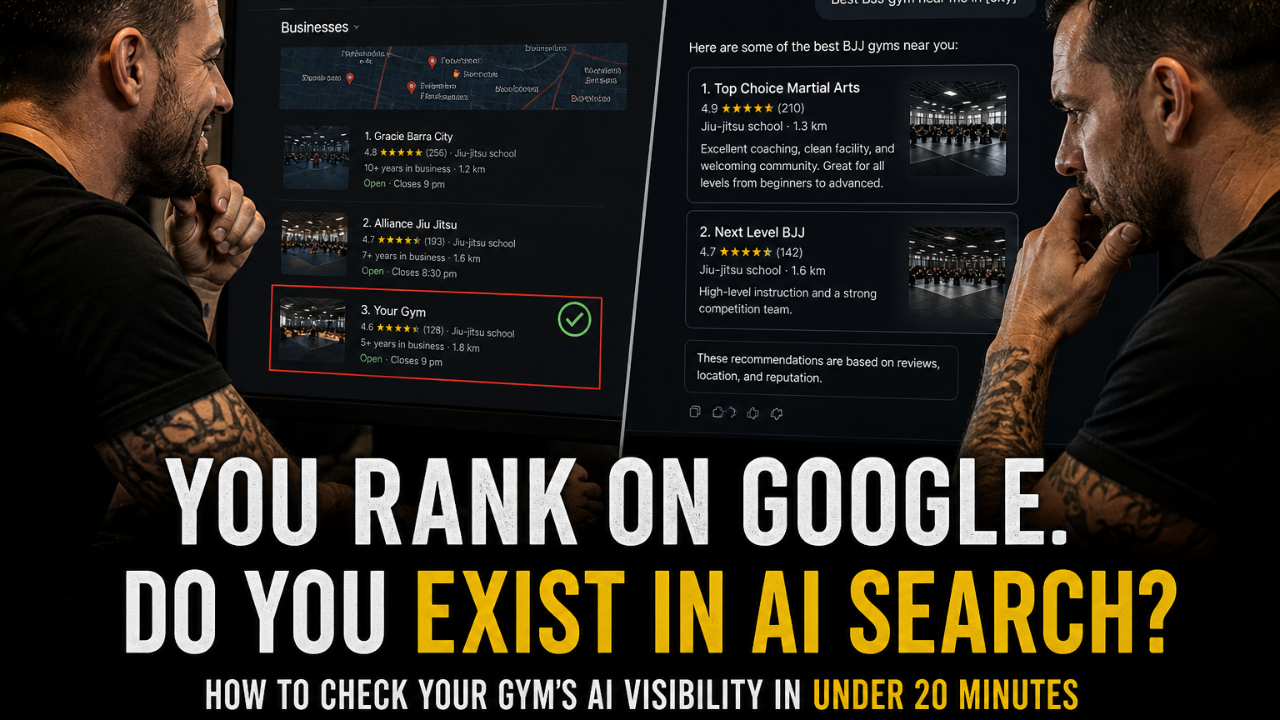
Is Your Gym Invisible in AI Search? Here's How to Find Out
May 04, 2026Your Google Ranking Is Not the Whole Story Anymore.
You've done the work on Google. You've claimed the listing. You've got some reviews. Maybe you've run ads or done some SEO at some point.
And for a while, that was the whole game.
It's not anymore.
A growing number of people, especially the ones most likely to become high-value, long-term members, are starting their search somewhere different. They're typing into ChatGPT. They're asking Google's AI overview. They're using Perplexity, Siri, or whatever AI tool lives on their phone.
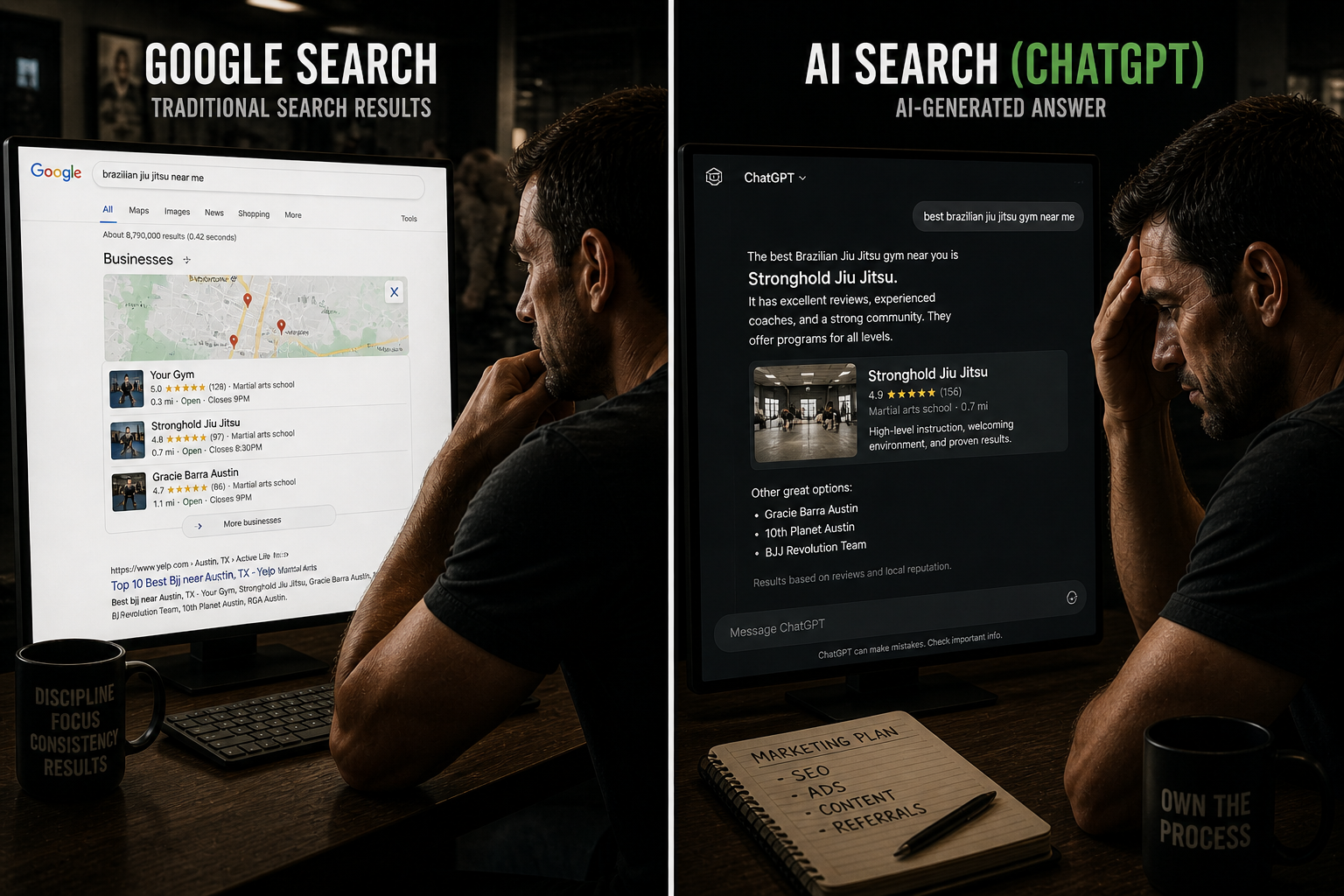
And those tools don't work like Google. They don't return a list of ten blue links and let the user decide. They give one answer. Maybe two. A short, confident recommendation built from everything the AI could find and understand about the gyms in your area.
If your gym isn't visible and credible in that layer — if the AI can't clearly understand who you are, who you serve, and why you're the right choice — you're not in the answer.
Your competitor is.
This blog tells you exactly how to check where you stand. No guessing. No vague audit checklists. A real self-diagnosis you can run in under 20 minutes and a clear picture of what to do next.
What Changed — And Why It Matters Right Now
Three years ago, "getting found online" meant ranking on Google. You optimised your website, built some local citations, collected reviews, and ran ads. That was the playbook.
That playbook still matters. But it's no longer complete.
Here's what's happening at the search layer your members are using:
AI tools are becoming the first filter. When someone moves to a new city and wants a BJJ gym, they don't always start with Google anymore. They ask ChatGPT. When a parent wants to find a kids' karate program, they might ask Google's AI overview, which now sits above the organic results and the local pack. When a competitive athlete wants the best MMA gym in town, they might ask Perplexity and take its top answer as the starting point.
AI tools give one answer, not ten options. Traditional search returns a list. The user compares. The user clicks around. Your gym might be option four and still get the lead.
AI search recommends. It says: "Based on what I know, this is the gym you should consider." If you're NOT that gym, you're not in the conversation at all.
AI tools decide based on signals you may not have optimised for. The signals AI tools use to evaluate and recommend a local business are different from traditional SEO signals. They look for clarity of identity: does this gym's online presence clearly explain what it is, who it serves, and where it is. They look for consistency: do all the data points across the web agree on the same gym. They look for proof: is there enough review volume, testimonial content, and real-world evidence to trust this recommendation.
Most gyms have not been optimised for any of those three things. They've been optimised for keyword rankings and ad impressions, which is a different game.
Here's the play: The gyms winning in AI search right now are not the ones with the biggest ad budgets. They're the ones whose digital presence is the clearest, most consistent, and most credible to an AI evaluating which gym to recommend. That's a fixable gap. But first you have to know where you stand.
The 3 Things AI Tools Use to Evaluate Your Gym
Before you run your self-check, understand what the AI is actually looking at.
AI search tools pull from your publicly available digital footprint: your website, your Google Business Profile, your reviews, your local directory listings, and any mentions of your gym across the web. They process all of that and try to answer one question: Is this gym a credible, clear, locally relevant answer to what this person is looking for?
They evaluate that question across three dimensions.
Dimension 1: Clarity
Does your gym's online presence immediately and clearly communicate:
- What type of gym is this (BJJ? MMA? Karate? All of the above?)
- Who is it for (beginners? competitors? kids? adults?)
- Where it's located (city, neighbourhood, area)
AI tools are not great at inferring. If your homepage headline says "Train with the best" and your About page talks about community without naming the programs, the AI has to guess what you are. And it will either guess wrong or skip you in favour of a gym that made it obvious.
Clarity is not about clever copywriting. It's about being plain, specific, and easy to parse.
Dimension 2: Consistency
Do all the places your gym appears online agree with each other?
Your name, address, and phone number: the NAP should be identical across Google, Facebook, Apple Maps, Yelp, and every directory that references your gym. One old address. One missing phone number. One listing that says "MMA Academy" while your website says "Combat MMA and BJJ", these inconsistencies create noise that AI tools interpret as unreliability.
An unreliable signal is a signal that doesn't get recommended.
Dimension 3: Proof
Does your digital presence show enough evidence that real people train at your gym, trust your coaching, and get results?
Proof means: Google review volume and recency. Photos of real training. Member testimonials. Results. A Google Business Profile that looks alive and active, not a placeholder with 14 reviews from 2021.
AI tools use proof signals to assess credibility. A gym with 80 current, specific reviews is a credible recommendation. A gym with 12 old reviews and stock photos is not.
The AI Visibility Self-Check (Run This Now)
This takes 15–20 minutes.
You need: your phone, a laptop, and honest answers.
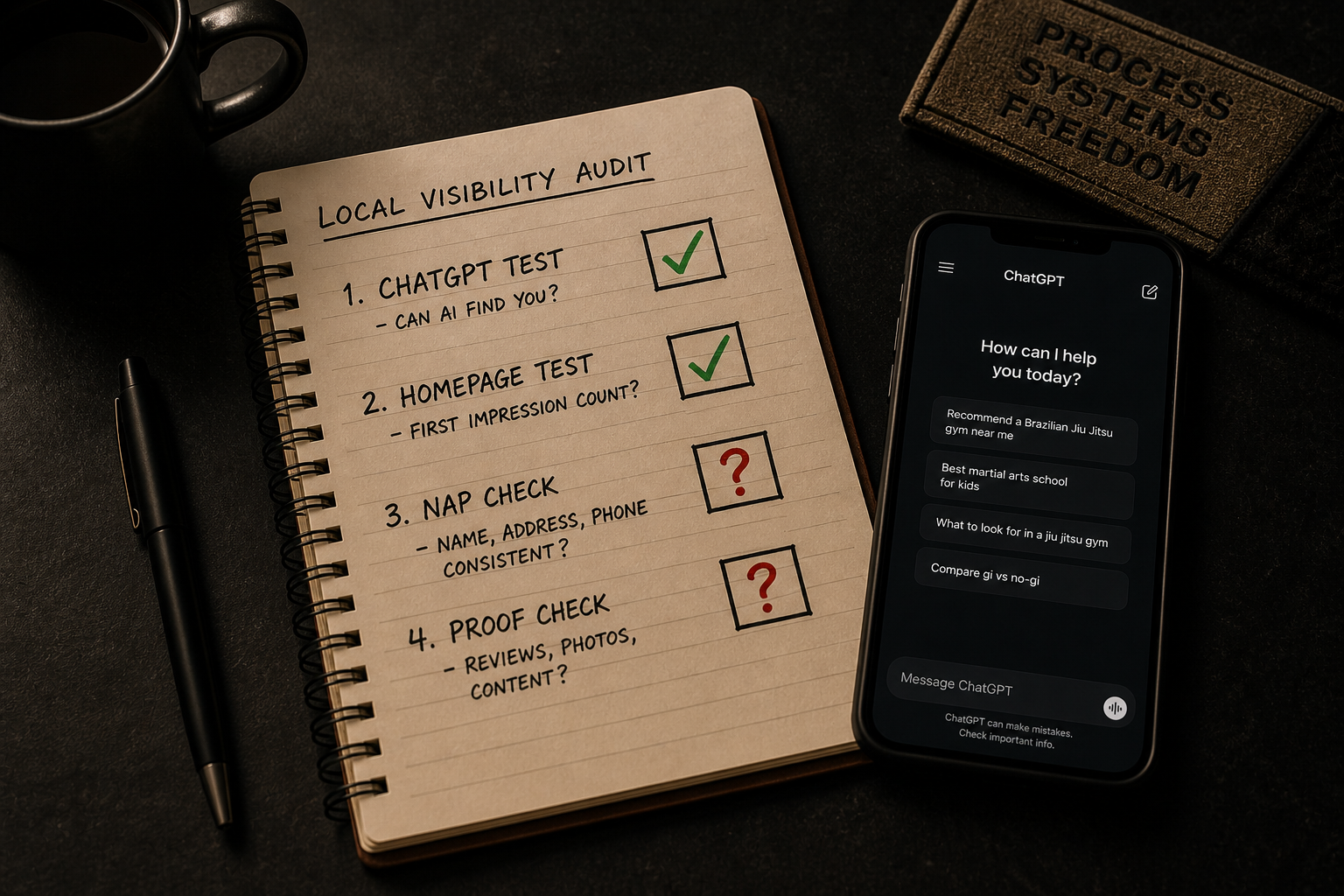
Test 1: The ChatGPT Test
Open ChatGPT (or any AI assistant available to you). Type:
"What's the best [BJJ / MMA / karate] gym in [your city]?"
Then try a variation:
"I'm a beginner looking for a [martial arts type] gym in [your neighbourhood or area]. What do you recommend?"
Note:
- Does your gym appear?
- If yes — what information does the AI use to describe you? Is it accurate?
- If no — which gyms appear, and what do their online profiles have that yours doesn't?
This is the most important test you can run. The answer tells you exactly where you stand in the conversation that is happening about gyms in your market right now.
Steal this: Screenshot the results. Save the competitor names the AI recommends. What you're looking at is the gym that is getting the new member inquiries you're not seeing.
Test 2: The 5-Second Homepage Test
Open your gym's homepage. Read only the headline and the text above the fold — everything visible before scrolling.
Ask yourself: can a total stranger answer these three questions from that content alone?
- What type of gym is this?
- Who is it for?
- Where is it located?
If any answer requires scrolling, clicking, or inferring, that's a Clarity gap. AI tools read above-the-fold content as the primary identity signal for your business. If it's vague up top, the AI doesn't get a clear answer.
Score yourself:
- All three answered clearly above the fold → Strong
- Two of three → Moderate gap
- One or none → Significant Clarity problem
Test 3: The NAP Consistency Check
Open four tabs: Google Business Profile, Facebook page, Yelp, Apple Maps.
Check your name, address, and phone number on each. They should be identical and not close, identical.
Common failures:
- Old address still showing on one platform after a move
- Phone number missing from one or two platforms
- Gym name formatted differently across platforms
- Hours wrong or absent on two or more listings
Score yourself:
- All four match exactly → Strong
- One or two have minor errors → Moderate gap
- Multiple mismatches or missing listings → Significant Consistency problem
Test 4: The Proof Check
Answer these four questions:
- How many Google reviews does your gym have? When was the last one posted?
- Does your Google Business Profile have at least 10 photos of real training (not stock images)?
- Does your website homepage or about page include at least two real member testimonials with names?
- Is there any content anywhere on your site that documents a member's progress or result?
Score yourself:
- Strong on all four → Strong
- Two or three → Moderate proof gap
- One or none → Significant Proof problem
What Your Results Mean
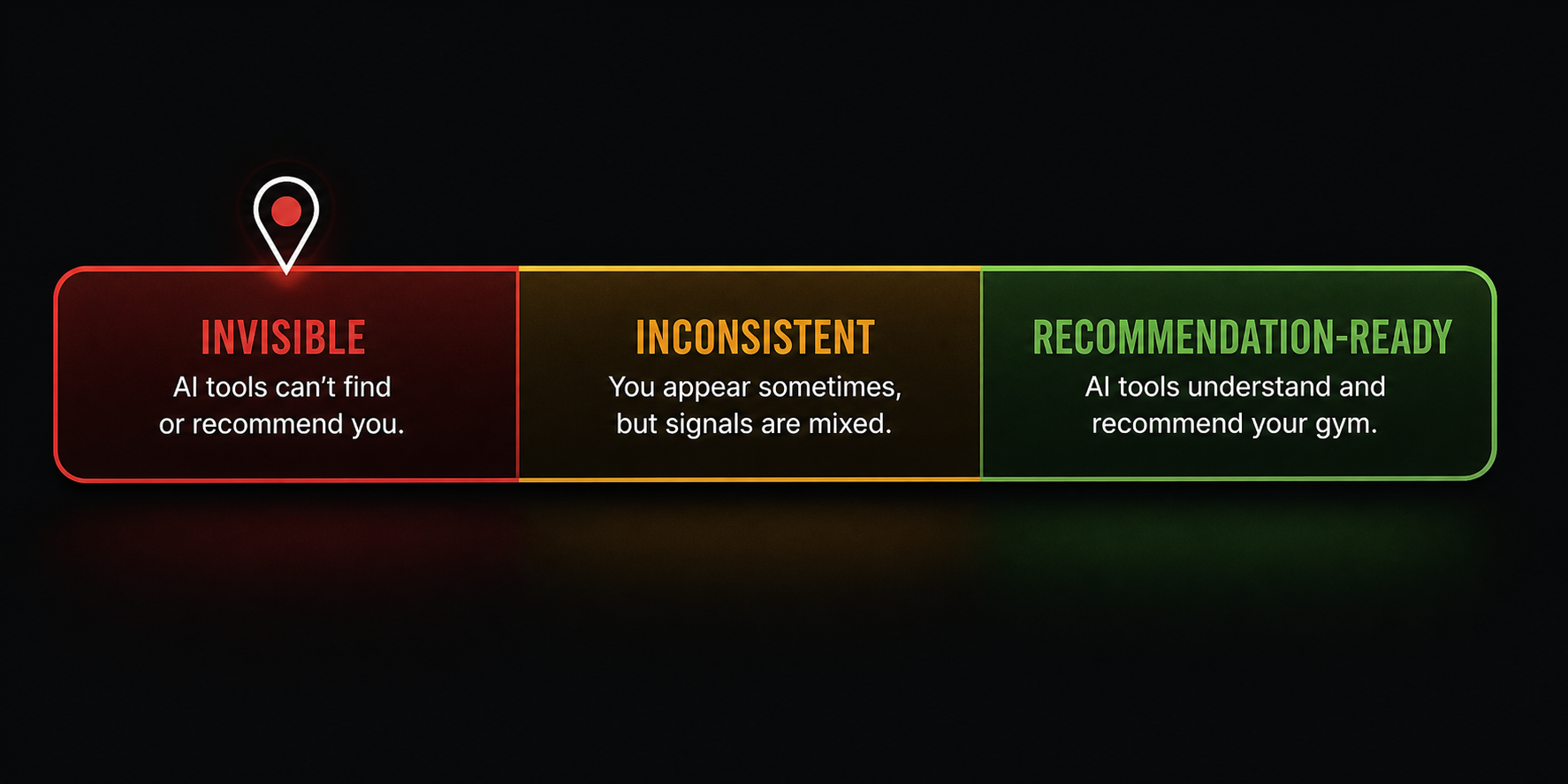
If you passed all four tests: Your gym has a solid AI visibility foundation. The next questions are about depth — how much proof you have, how frequently your profile gets updated, and whether the content on your site is specific enough to be quoted by AI tools. A full audit will identify the fine-tuning opportunities.
If you failed one or two tests: You have specific, fixable gaps. The good news: these are not abstract or technical problems. A Clarity gap means rewriting a headline. A Consistency gap means correcting a few listings. A Proof gap means running a review campaign. Each fix produces visible impact on AI visibility within 30 to 60 days.
If you failed three or all four: Your gym is effectively invisible in AI search right now. Not in the running. Not in the conversation. Every person who searches for a gym in your area using an AI tool and gets a competitor recommended is a lead you paid the market to generate — that went somewhere else.
This is not a small problem. But it is a solvable one.
The Most Common Reason Gyms Fail the ChatGPT Test
Here is what we see consistently when we audit a gym that doesn't show up in AI search.
It's almost never one catastrophic failure. It's three moderate problems that compound each other.
The homepage is written for humans, not for AI. The headline is a tagline. The about page talks about passion and community without naming the programs, the location, or the audience clearly. The AI tries to parse it and gets ambiguous signals. So it moves on to the gym that made it easy.
The local listings are an afterthought. The Google Business Profile was set up two years ago and hasn't been touched since. The business category is too broad. The description doesn't include program keywords. The photos are three low-quality images from opening day. The reviews haven't moved in eight months.
The proof layer is thin. Fourteen reviews. No testimonials on the website. No documented results. Nothing that shows a skeptical AI (or a skeptical new member) that real people train here and real outcomes happen on these mats.
None of these is complicated to fix. All of them are invisible until someone runs the audit.
Here's the play: The fix doesn't start with a new ad campaign. It starts with a clear score and a prioritised list of what to address first. That's exactly what the Tribe AI audit produces.
→ Get your AI visibility score → Tribe AI
System vs. Chaos: What AI-Visible vs. AI-Invisible Looks Like
|
❌ AI-Invisible Gym |
✅ AI-Visible Gym |
|
Homepage headline is a tagline — vague, non-specific |
Above-the-fold copy names the gym type, audience, and location clearly |
|
Google Business Profile last updated 8+ months ago |
GBP updated regularly — posts, photos, Q&A active |
|
NAP inconsistent across platforms |
Name, address, phone identical on every listing |
|
12 Google reviews, last posted 6 months ago |
50+ reviews, consistent recent volume |
|
No testimonials or results on website |
Member testimonials and results visible on homepage |
|
Programs listed without description |
Each program describes who it's for and what to expect |
|
Doesn't appear in ChatGPT or Google SGE results |
Appears in AI recommendations for local martial arts searches |
|
Owner doesn't know their AI visibility score |
Score tracked, gaps identified, fixes in progress |
What Fixing This Actually Looks Like
Here's the sequence. It's not complicated. It's just not something most gym owners have done because nobody told them this was the game.
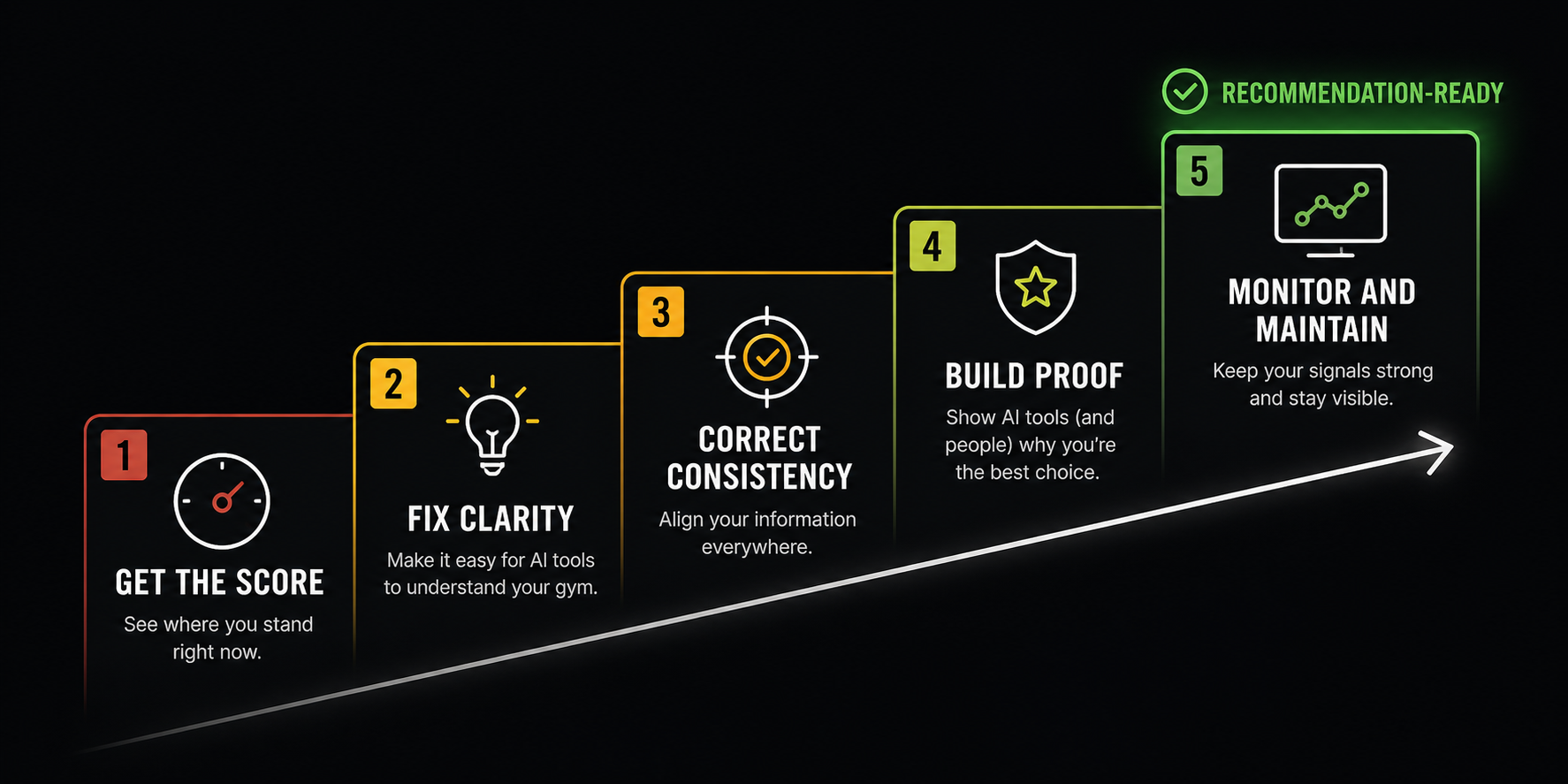
Step 1: Get the score. Not a guess. Not "we're probably fine." A real audit: Clarity, Consistency, Proof — with a number and a prioritised list of gaps. That is where this starts.
Step 2: Fix Clarity first. Rewrite the above-the-fold copy on your homepage. Make the what, who, and where impossible to miss. This is a one-hour task that produces immediate AI visibility improvement.
Step 3: Correct the Consistency gaps. Audit your four primary listings. Correct any NAP mismatches. Update business categories, hours, and descriptions to include program and location keywords.
Step 4: Build the Proof layer. Run a review campaign to active members. Add real testimonials to the website. Upload current training photos to your Google Business Profile. Add program descriptions that answer the beginner's questions.
Step 5: Monitor and maintain. AI visibility is not a one-time fix. It's an ongoing signal. The gyms that stay recommendation-ready treat their digital presence as operational infrastructure — updated, audited, and maintained on a schedule.
That is what Tribe AI is built to do — score the gaps, fix the foundation, and keep the gym recommendation-ready as search behaviour continues to evolve.
→ Start with the audit → Tribe AI
FAQ: AI Search Visibility for Martial Arts Gyms
What is AI search and why does it matter for my martial arts gym?
AI search refers to tools like ChatGPT, Google SGE, and Perplexity that answer questions directly — including questions like "what's the best BJJ gym near me." Unlike traditional Google search, which returns a list of results the user chooses from, AI search gives a recommendation. The gym it recommends gets the lead. The gyms it doesn't mention don't exist in that interaction. As more buyers use AI tools to start their search, AI visibility is becoming a primary lead generation factor for local martial arts gyms.
How do I check if my BJJ gym appears in AI search results?
Open ChatGPT, Google SGE, or any AI assistant and search for the best gym of your type in your city or neighbourhood. Use variations — "best BJJ gym for beginners near [area]" and "MMA gym in [city] for adults." Note which gyms appear and which information the AI uses to describe them. If your gym doesn't appear, compare your Google Business Profile, website clarity, and review volume against the gyms that do. The gap between you and them is your starting audit list.
Why does my gym show up on Google but not in AI search?
Google search and AI search use different signals. Google rewards keyword density, backlinks, and local citation volume. AI tools evaluate clarity — can it understand what your gym is and who it serves — consistency — do all your listings agree — and proof — is there enough social evidence to make a credible recommendation. A gym can rank on Google page one and still be effectively invisible in AI search if its homepage is vague, its listings are inconsistent, or its review profile is thin. These are separate problems with separate fixes.
How many Google reviews does a martial arts gym need to appear in AI recommendations?
There is no fixed number, but pattern recognition across audits suggests that gyms with fewer than 30 reviews rarely appear in AI recommendations for competitive local markets. Gyms with 50 or more recent, specific reviews — especially those that mention program types, coach names, and beginner experience — appear significantly more often. Volume matters. Recency matters more. A gym with 80 old reviews loses ground to a gym with 40 reviews that is actively collecting new ones each month.
What is a Tribe AI audit and what does it include?
A Tribe AI audit scores a martial arts gym's AI visibility from 0 to 100 across three dimensions: Clarity (does the gym's digital presence clearly communicate who and what it is), Consistency (do all local listings agree on name, address, and phone), and Proof (does the gym have sufficient review volume, photos, and testimonial content to be credible to AI systems). The audit produces a score, identifies the specific gaps costing the gym AI visibility, and delivers a prioritised fix list. It is the starting point for every Tribe AI engagement.
How long does it take for AI visibility improvements to show results?
Clarity fixes — rewriting above-the-fold copy, updating business descriptions — can produce changes in AI recommendation patterns within 2 to 4 weeks. Consistency fixes — correcting local listing data — typically produce local search and AI signal improvements within 30 days. Proof improvements — building review volume — compound over time and typically show meaningful AI visibility impact at 60 to 90 days. The full compounding effect of all three fixes together is usually visible at the 90-day mark as a measurable improvement in how the gym appears in AI-assisted searches.
Is AI search visibility just for big gyms with big marketing budgets?
No. AI visibility favours clarity and consistency over budget. A single-location BJJ gym with a well-optimised Google Business Profile, a clear homepage, and 60 current reviews will out-rank a multi-location competitor with a vague digital presence and mismatched listings — in AI search. The playing field is more level than traditional paid advertising. The gyms winning in AI search right now are not the ones spending the most. They are the ones whose digital presence is the easiest for AI tools to understand and trust.
You're Either in the Answer or You're Not.
There is no middle ground in AI search.
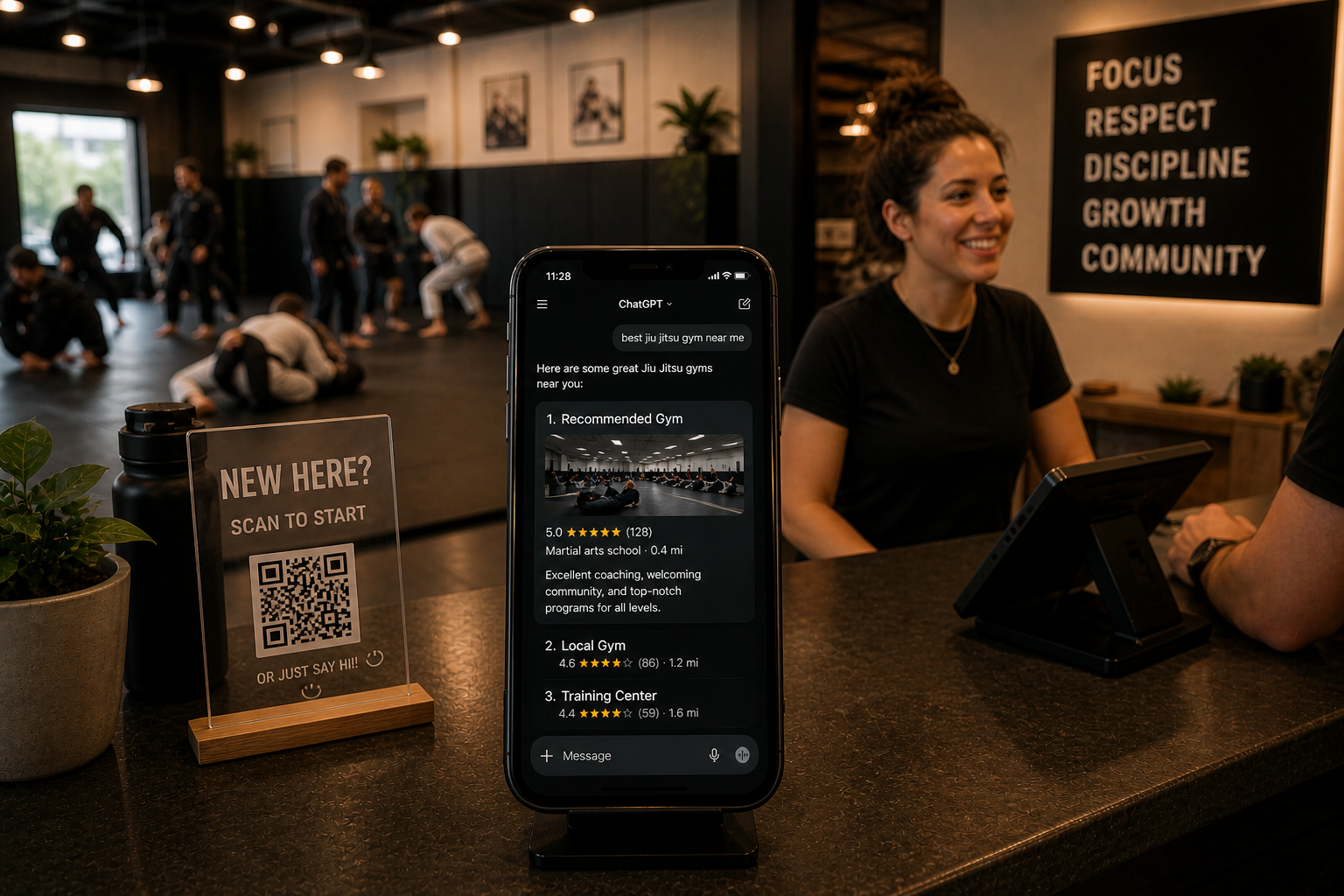
When someone asks for the best BJJ gym in your city and an AI tool answers — either your gym is in that answer or it isn't. Either you're the recommendation or a competitor is. Either the lead comes to you or it goes somewhere else.
The gyms that show up are not spending more on ads. They are simply more visible to the tools that are mediating local search right now. Their digital presence is clear, consistent, and credible enough that AI tools can recommend them with confidence.
Yours can be too.
It starts with a score. Not a guess. Not a hope. A real number — Clarity, Consistency, Proof — that tells you exactly where the gaps are and what to fix first.
That's the Tribe AI audit. It's where this starts.
Find out where your gym stands before your competitor does.
→ Get Your AI Visibility Score → Tribe AI
