
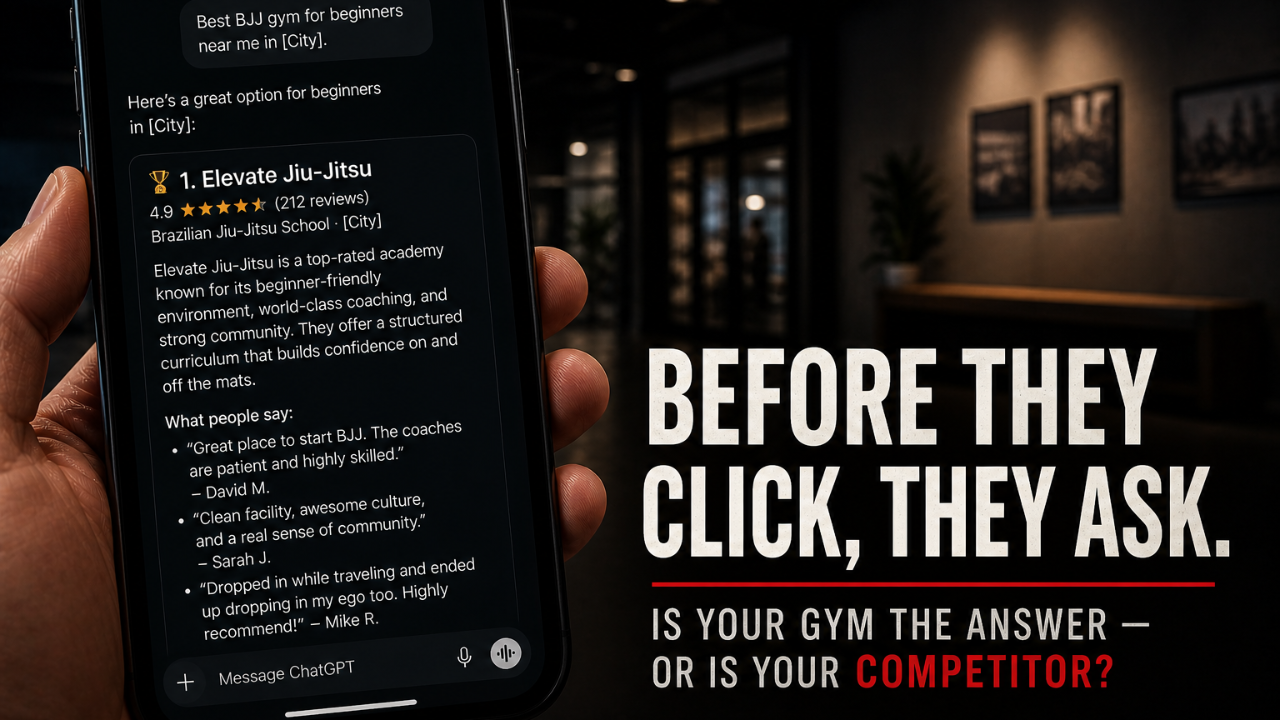
Before They Click, They Ask. Is Your Gym the Answer?
May 18, 2026Someone Just Asked for a Gym. It Wasn't Yours.
Right now — today — someone in your market is looking for a gym.
Not browsing. Not scrolling Instagram waiting to be inspired. Actively looking. They've made the decision to start training. They want to find the right place.
And they didn't open Google and scan ten results.
They typed a question into ChatGPT. Or asked Siri. Or looked at Google's AI overview — the answer block that now sits above everything else on the results page.
The AI gave them a name. Maybe two.
Was yours one of them?
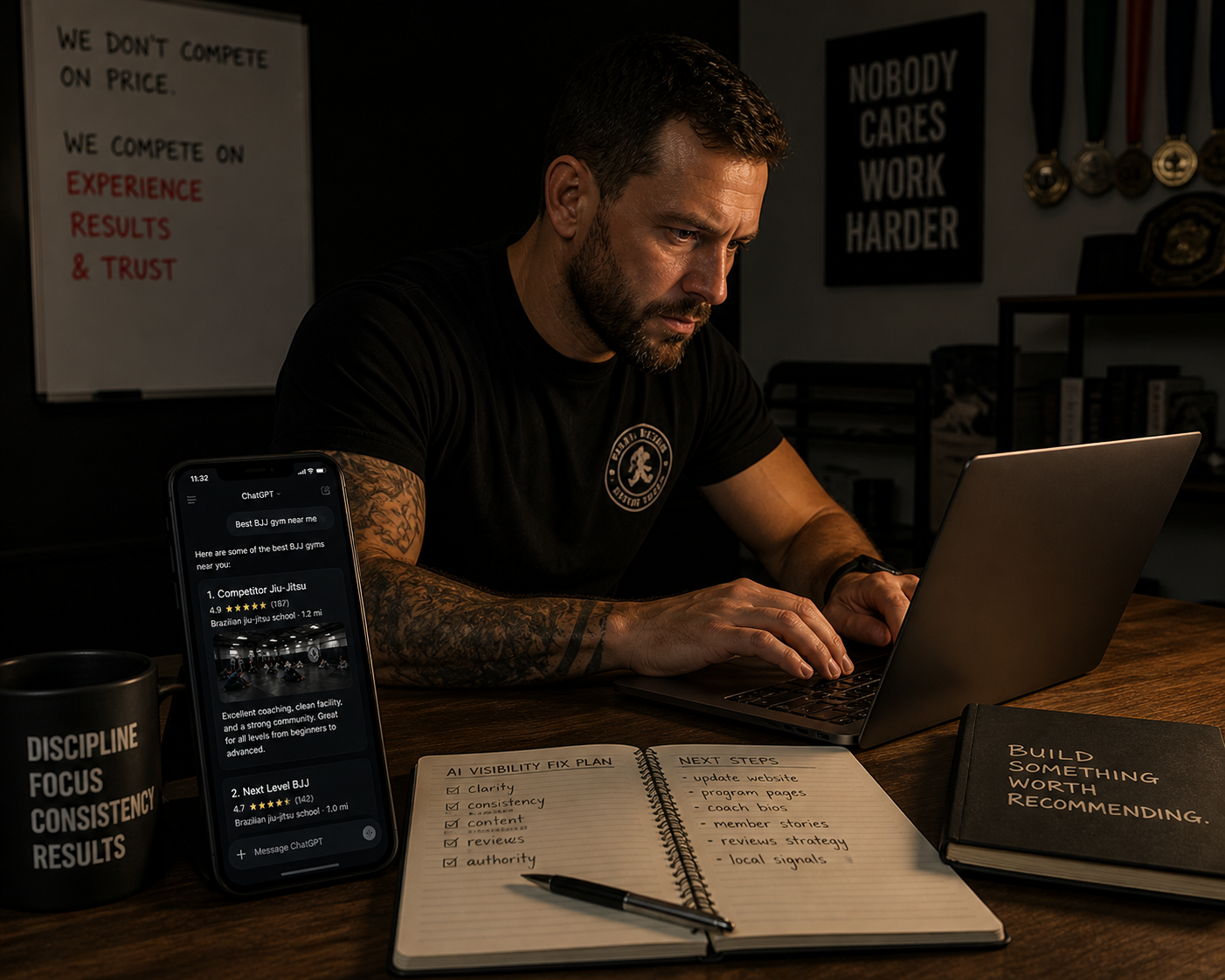
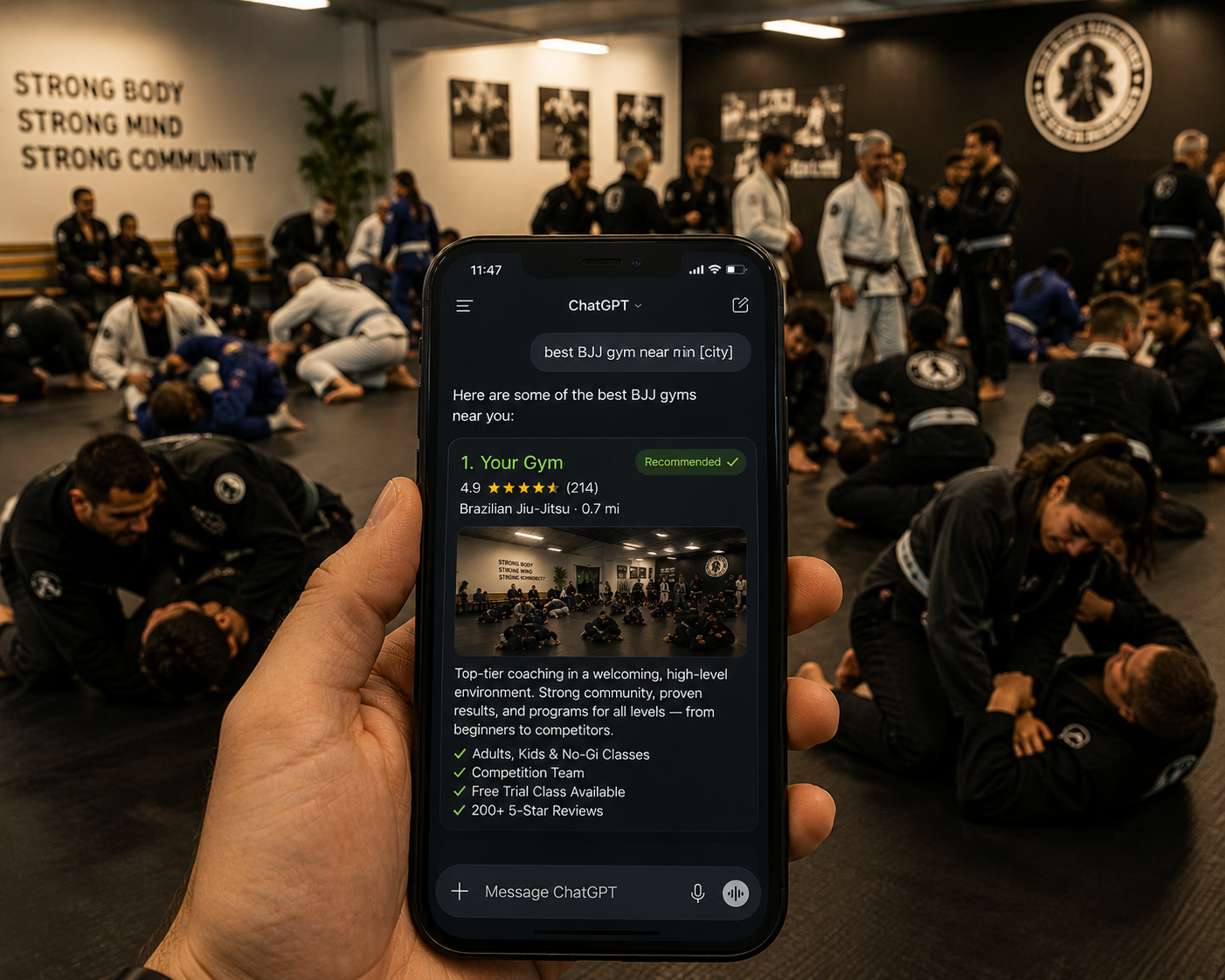
If you haven't run the test from Blog 1 yet — go do it now. Open ChatGPT. Type: "Best BJJ gym near me in [your city]." Read what comes back.
If your gym is in the answer — good. This blog will tell you how to stay there and pull further ahead.
If your gym is not in the answer — that inquiry just went to whoever is.
And here's the part that should sharpen your attention: that's not a one-time miss. That is every inquiry generated by AI search in your market, every day, going to the gym the AI trusts enough to recommend. While yours waits to be found by people who happen to scroll far enough down a Google results page.
This is the gap. This blog closes it.
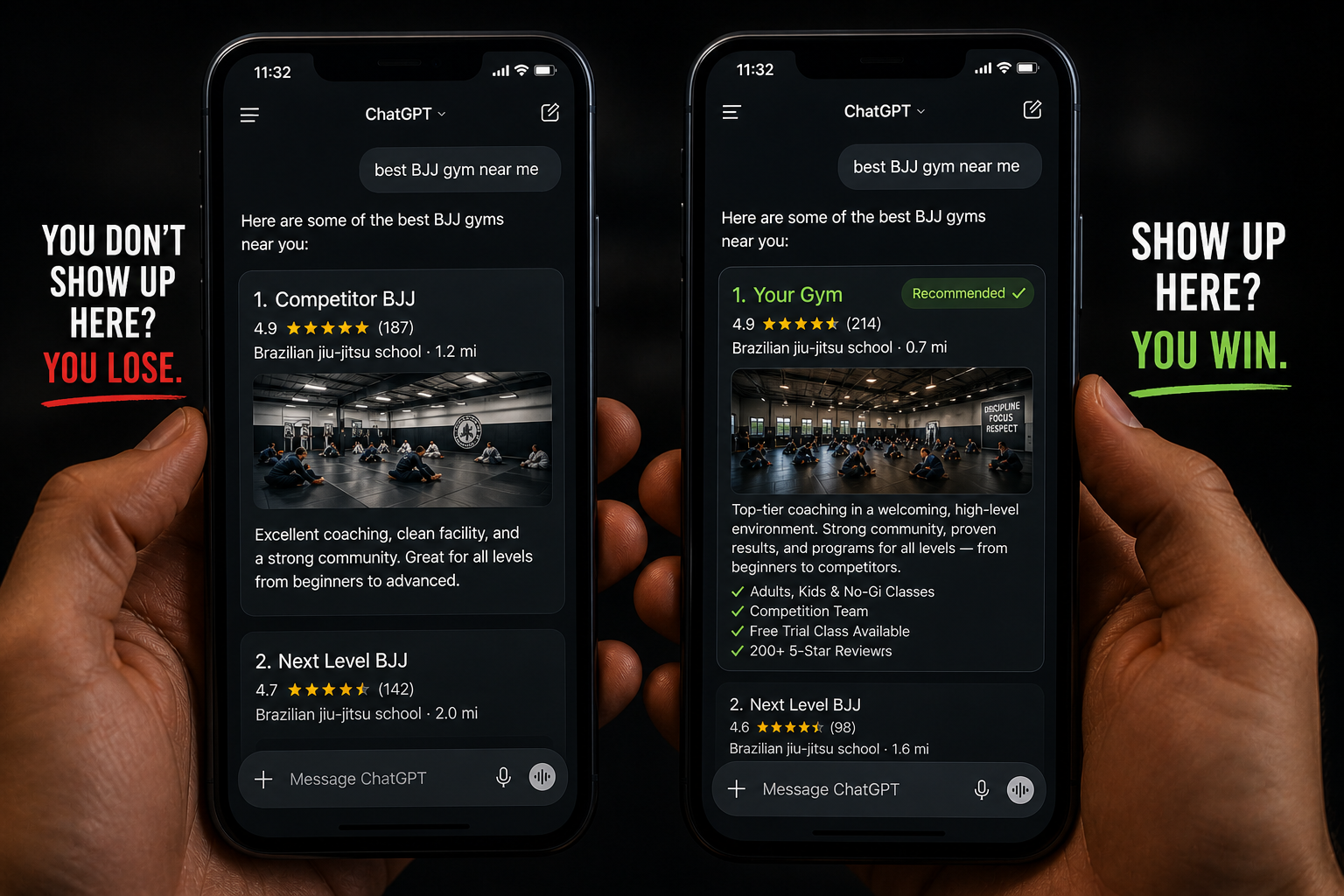
The Search Has Already Changed. Most Gyms Haven't.
Here is what the old buyer journey looked like.
Someone decides they want to try BJJ. They Google "BJJ gym near me." They see a local pack of three gyms with star ratings and reviews. They click through two or three websites, compare, and contact the one that looks best.
That journey still exists. But it is no longer the only journey — and for a growing segment of buyers, it is no longer the first one.
Here is what the new buyer journey looks like.
Someone decides they want to try BJJ. They ask ChatGPT: "I'm a complete beginner, a bit nervous about starting, what's the best BJJ gym in [city] for someone like me?"
The AI responds with one gym. Maybe two. It describes them in terms of beginner-friendliness, atmosphere, coaching quality — drawn from the reviews, website content, and structured data it can find. It gives a recommendation with enough confidence that the buyer treats it as a starting point.
They go directly to that gym's website. They book a trial. They never see your gym at all.
This is not a future scenario. This is happening in your market today.
The gyms that understand this — and act on it — are quietly pulling ahead. Not with bigger ad budgets. Not with more posts. With a better digital signal that AI tools can read, trust, and recommend.
Why the Gym AI Recommends Is Not Always the Best Gym
This is the part that frustrates good gym owners most — and rightfully so.
The gym that AI recommends is not necessarily the best gym in the market. It's the most legible gym. The most consistent gym. The gym whose digital presence makes it easiest for an AI to form a confident recommendation.
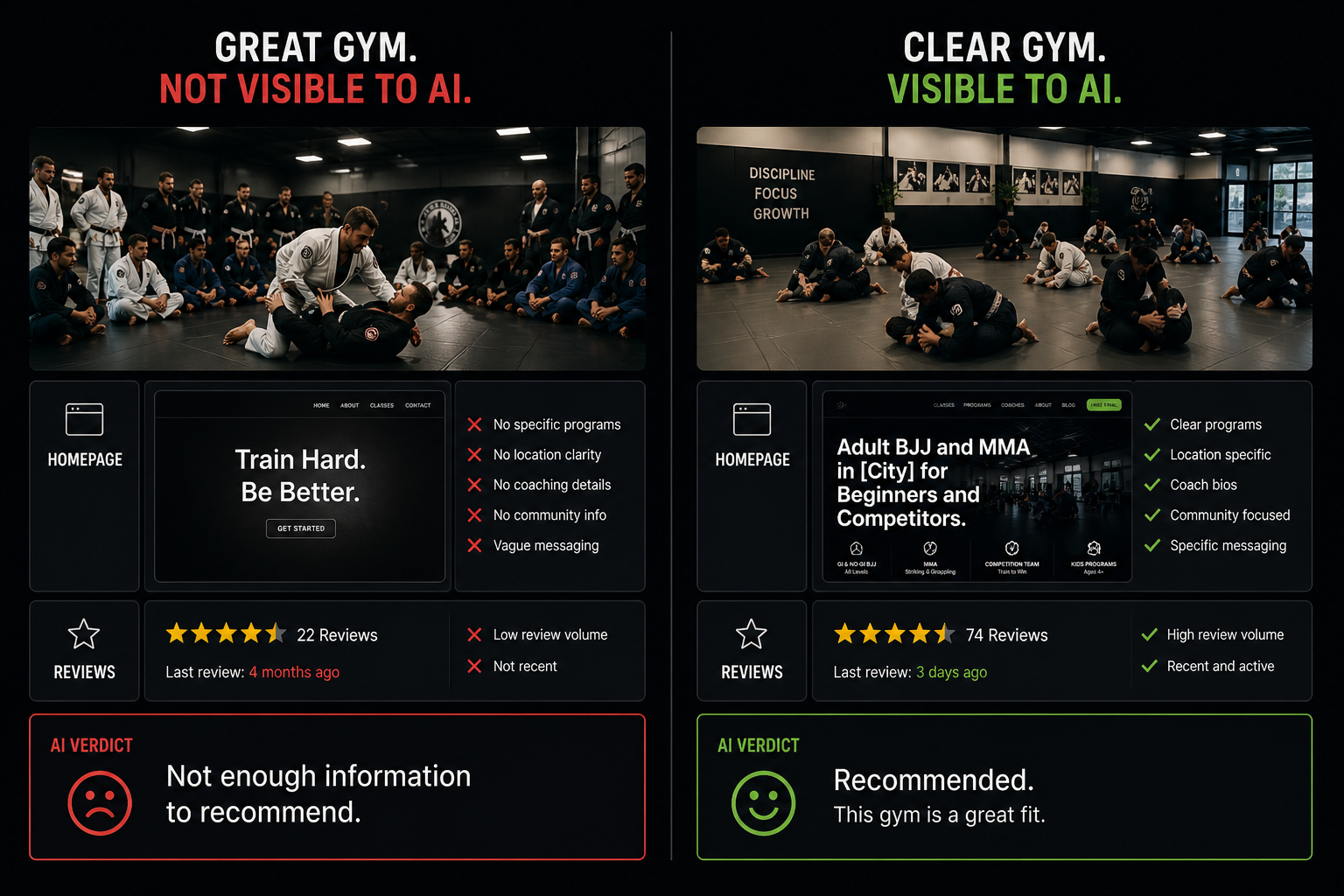
A gym with a vague homepage, mismatched local listings, and 22 old reviews might be the best training environment in the city. But if the AI can't clearly parse who the gym serves, can't verify its location signals, and can't find enough social proof to feel confident recommending it — that gym is invisible.
Meanwhile, a competitor with a clear above-the-fold headline, 70 recent Google reviews, and consistent NAP data across every directory gets recommended — not because they're better, but because they're clearer.
That is both frustrating and useful information.
Frustrating because quality should win. Useful because clarity is completely within your control.
Here's the play: The gym that wins AI search is not the gym with the biggest budget. It's the gym that made it easiest for AI to understand, verify, and trust. Every one of those variables is fixable. The audit tells you which ones to fix first.
What "Being the Answer" Actually Requires
You don't need to understand AI algorithms. You need to understand what AI tools are looking for when they evaluate your gym — and make sure your digital presence delivers it clearly.
There are three things. The same three things every Tribe AI audit measures. The same three things that separate the gym that gets recommended from the gym that doesn't.
- Clarity: Can the AI immediately understand what your gym is?
The first signal AI tools look for is identity clarity. Not cleverness. Not branding. Identity. What type of gym. Who it's for. Where it's located.
If your homepage headline is a tagline — "Train with the best." "Warriors are made here." "Your journey starts now." — the AI has to work to figure out what you actually are. And AI tools don't work to understand vague signals. They move toward the gym that made it easy.
The gym that is "the answer" has a homepage that says, clearly and immediately: "Adult BJJ, kids martial arts, and MMA in [Neighbourhood], [City]. Beginner-friendly. No experience needed."
That's not less compelling. That's more findable. And findable wins.
- Consistency: Do all your signals agree?
Every time your gym's name, address, or phone number appears differently across different platforms, you are sending a conflicting signal to AI tools trying to verify your business. Google, Apple Maps, Yelp, Facebook, Foursquare, and a handful of data aggregators all contribute to the profile an AI builds of your gym.
One old address. One missing phone number. Your gym name formatted as "Combat BJJ" in one place and "Combat Brazilian Jiu-Jitsu Academy" in another. These inconsistencies are invisible to you. They are very visible to the systems deciding whether to recommend you.
Consistent NAP data across every listing is table stakes for AI visibility. It's also one of the fastest fixes — and most gyms haven't done it.
- Proof: Is there enough evidence to make a confident recommendation?
AI tools do not recommend businesses they can't verify are real, active, and trusted. They look for social proof — the volume and recency of Google reviews, the presence of real member photos, the existence of testimonials and results on your website.
A gym with 11 reviews from 2022 is not a confident recommendation. A gym with 65 reviews — including 15 posted in the last 90 days, multiple of which mention the beginner experience, the coaching quality, and specific program names — is.
The AI is doing what a thoughtful friend would do when recommending a gym: checking that the place is legit, active, and actually good for the person asking. Your proof layer is what gives the AI the confidence to say your name.
The Competitive Cost of Being Invisible in AI Search
Let's put a number on this.
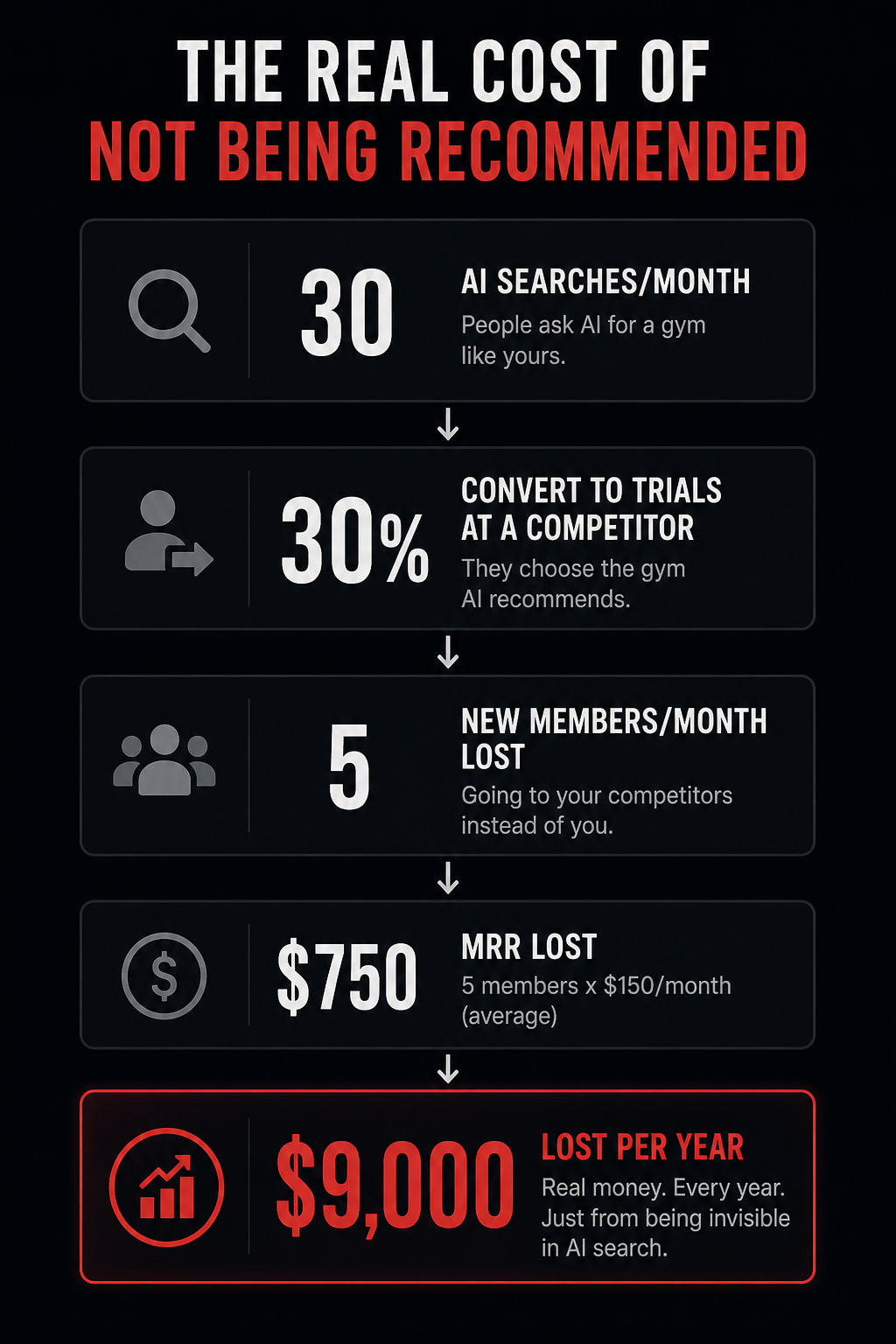
Assume your market generates 30 genuine gym-seeker interactions through AI search per month. People actively looking, typing a question, getting a recommendation.
If your gym is not the answer — if a competitor is — and even 30 percent of those people convert into trial bookings at that competitor's gym, that's 9 trials per month going somewhere that is not your gym.
At a conservative trial-to-member conversion rate of 50 percent, that's 4 to 5 new members per month your competitor is collecting from a channel you're not competing in.
At $150 average monthly membership value, that's $600 to $750 per month in recurring revenue — $7,200 to $9,000 per year — going to a gym that is not yours.
Not because they have a better product. Not because they outspent you on ads. Because an AI tool can understand and trust them clearly enough to put their name in the answer.
That number is not the ceiling. It's the floor. And it compounds every month the gap is open.
Steal this calculation: Take your average monthly membership value. Multiply by 4. That's a conservative estimate of what AI search invisibility is costing you annually in lost members to visible competitors. Write it down. That number is the ROI argument for fixing this.
The Gyms Already Winning This — What They Did
The gym owners who are currently showing up in AI search recommendations didn't do anything exotic. They fixed the basics — deliberately and specifically.
Here is what that work looked like in practice.
They rewrote their homepage headline. Specific. Clear. Who, what, where — above the fold, no scrolling required. Not "Train with the best." Something like: "BJJ and MMA classes in [Neighbourhood], [City] — for beginners and serious athletes. Structured. Welcoming. No ego."
That change alone shifted how AI tools understood and categorised the gym.
They audited and corrected every local listing. NAP consistent across Google, Apple Maps, Yelp, Facebook, and the top ten data aggregators. Business category updated to reflect actual offerings. Business description rewritten to include program keywords, location signals, and audience language.
They ran a structured review campaign. Not a mass email blast. A personal, coach-to-member ask that explained why reviews matter and made the action take 90 seconds. Volume went from 18 reviews to 54 in 45 days. Recency went from nothing new in six months to three to five new reviews per month on a rolling basis.
They added proof to their website. Two member testimonials on the homepage — real names, real outcomes. A results page with three member stories. Program pages rewritten to answer the beginner's actual questions — what do I wear, what will happen in my first class, will I be the only person who doesn't know what they're doing.
None of that is technical. None of it requires an agency. All of it produces measurable AI visibility improvement within 30 to 90 days.
What it requires is knowing exactly which of those things to prioritise — which is what the audit tells you.
System vs. Chaos: The Gym That Gets Recommended vs. The Gym That Doesn't
|
❌ Not the Answer (AI-Invisible) |
✅ The Answer (AI-Visible) |
|
Homepage headline is a tagline — AI can't parse identity |
Homepage names program type, audience, and location clearly |
|
Business listings have NAP inconsistencies across platforms |
NAP identical on every listing — consistent, verified signal |
|
18 Google reviews, last posted 7 months ago |
60+ reviews, 5–8 new per month, recent and specific |
|
No testimonials or results on website |
Real member testimonials and results visible above the fold |
|
Program pages list class times — no description of who they're for |
Program pages answer who it's for and what the first class looks like |
|
Doesn't appear when someone asks ChatGPT for a local gym |
Appears as a top recommendation in AI-assisted local search |
|
Owner doesn't know their AI visibility score |
Score tracked quarterly, gaps identified, fixes in progress |
|
Leads coming from Google only — AI channel producing nothing |
Leads coming from both Google and AI-mediated discovery |
What to Do This Week
You don't need a six-month project. You need a score and a starting point.
This week:
Run the ChatGPT test. Open the tool, type the query, read the answer. Screenshot it. If your gym is not in the result — you have confirmed the problem exists in your specific market. That's the data you need to move forward.
Then visit Tribe AI and get the full audit.
The audit scores your gym 0 to 100 across Clarity, Consistency, and Proof. It tells you exactly which dimension is costing you the most AI visibility right now. And it delivers a prioritised fix list — not a generic recommendations report, a specific action sequence built for your gym.
That is where this starts. Everything else — the headline rewrite, the listing corrections, the review campaign, the proof layer — follows from the score.
Here's the play: The gym that gets the audit done this week is two to three months ahead of the competitor who reads this blog, nods along, and does nothing. This is the part where intention becomes action — or doesn't.
→ Get your AI visibility score → Tribe AI
FAQ: AI Search Visibility, Competitor Gaps, and Getting Your Gym Found First
Why is my competitor showing up in AI search but my gym isn't?
Almost always it comes down to one or more of three gaps: their homepage is clearer about what they offer and who they serve, their local listing data is more consistent across platforms, or their review volume and recency is higher than yours. AI tools evaluate these signals when deciding which gym to recommend. The competitor being recommended is not necessarily a better gym — they simply have a more legible digital presence. Each of those gaps is auditable and fixable, usually within 30 to 90 days.
Does running Google Ads help my gym appear in AI search?
No. Paid search advertising and AI search visibility are separate channels. Google Ads buys placement in paid search results. AI search tools — including Google SGE — evaluate organic signals: website clarity, local listing consistency, review volume and sentiment, and structured content. Spending more on ads does not improve your AI visibility score. The fix is in your digital foundation — not your ad budget.
How often do people actually use AI tools to search for local gyms?
The behaviour is growing faster than most gym owners realise. Google's own data shows that AI overview results now appear for a significant portion of local search queries. ChatGPT usage for local business discovery has increased substantially year-over-year. For the 25–45 demographic — the primary adult martial arts market — AI tool adoption is particularly high. The exact percentage varies by market, but the direction is consistent and one-way: AI-mediated search is growing as a share of total local discovery, not shrinking.
What is the fastest thing I can do to improve my gym's AI search visibility?
Rewrite your homepage headline to clearly name your gym type, audience, and location — then verify your Google Business Profile NAP is accurate and complete. These two changes address the Clarity and Consistency dimensions simultaneously and can produce measurable AI visibility improvement within two to four weeks. The second fastest fix is a targeted review campaign to active members — volume and recency are the most impactful Proof signals for AI recommendation algorithms.
Is AI search visibility different from SEO?
Related but distinct. Traditional SEO optimises for keyword rankings in Google's organic results — primarily driven by backlinks, on-page content, and technical site health. AI search visibility optimises for how well AI tools can understand, verify, and trust a local business — primarily driven by identity clarity, NAP consistency, and social proof signals. A gym can rank well for SEO and be nearly invisible in AI search, and vice versa. The fixes overlap in some areas — local citation consistency matters for both — but the strategic priorities are different.
Can a small single-location gym compete with larger chains in AI search?
Yes — and often more effectively. AI search tools favour specificity and community signal over scale. A single-location BJJ gym with a clear identity, consistent local listings, and 70 specific reviews from real members often outperforms a multi-location chain with inconsistent franchise data and generic brand content. The playing field in AI search is more level than in paid advertising. The variables that determine recommendation — clarity, consistency, proof — are entirely within the control of an owner-operated gym.
What happens after I get my Tribe AI audit score?
The audit produces a score from 0 to 100 across Clarity, Consistency, and Proof, along with a prioritised fix list specific to your gym. From there, the work is sequenced: fix the highest-impact gap first, build from there. Tribe AI supports the implementation — the homepage language, the listing corrections, the review campaign structure, the proof layer build — so the score moves from wherever it starts toward recommendation-ready. Most gyms see meaningful AI visibility improvement within 60 to 90 days of starting the fix sequence.
The Question Is Being Asked Right Now. What's the Answer?
Every day, in your market, potential members are asking AI tools for a gym recommendation.
Some of them are asking for exactly what you offer — the right program, the right level, the right location. Buyers who would train with you for years if they knew you existed.
The AI is answering. It's putting a name in front of those buyers and shaping their first impression before they've clicked a single link, seen a single ad, or heard a single word from you.
That name is either yours or a competitor's.
The gap between those two outcomes is not talent, budget, or market. It's a score. Three dimensions. A prioritised list of fixes. Work that compounds over 60 to 90 days into a digital presence that AI tools understand well enough to recommend — consistently, confidently, and ahead of whoever is currently in your spot.
The audit is where this starts. The audit is fast. The audit tells you exactly what you're working with and what to do first.
Find out if your gym is the answer. Before your competitor does.
→ Get Your AI Visibility Score → Tribe AI
